Underride
A car slides beneath the trailer and the occupant compartment takes the impact at windshield height. Rear guards are federally mandated and routinely found corroded or non-compliant; side underride guards are still not required at all.
Semi-truck & tractor-trailer crashes
A loaded tractor-trailer runs to 80,000 pounds. A mid-size sedan runs to about 3,500. Physics decides the injuries; the paperwork decides who pays for them.
Corridors we work
Most people who call us after an 18-wheeler crash on I-20 or US 69 are not asking about liability theory. They are asking whether they will walk again, how the mortgage gets paid, and why an adjuster from a company they have never heard of already left a voicemail. Those calls tend to come in the same week the carrier's investigator has already been to the scene.
What follows is what actually determines the outcome of a semi-truck case in Smith County, the collision mechanics, the records that prove them, and the deadlines that quietly close the door. For the broader picture, including Texas deadlines and who can be held liable, start with our Tyler truck accident lawyer overview.
Loaded tractor-trailer
80,000 lb
Mid-size car
3,500 lb
≈23× the mass. Federal law caps a rig at 80,000 pounds gross on the interstate system without a permit; overweight loads are a recurring finding in serious cases.
Collision mechanics
The crash type tells you which records to demand. Each one leaves a different evidentiary fingerprint.
A car slides beneath the trailer and the occupant compartment takes the impact at windshield height. Rear guards are federally mandated and routinely found corroded or non-compliant; side underride guards are still not required at all.
The trailer swings out until the rig folds at the coupling. Usually traceable to braking on a wet surface, an empty or unevenly loaded trailer, or brakes out of adjustment across the axles.
High centre of gravity plus entry speed. Common on cloverleaf ramps along I-20 and on tanker loads where liquid surge shifts the load mid-curve.
The "no-zone" extends well behind and to the right of a tractor-trailer. Mirror discipline and a failure to clear the lane are the usual findings.
A loaded 80,000-pound rig needs roughly 20-40% more stopping distance than a passenger car, considerably more on wet asphalt or with worn linings.
Steer-tire failure at highway speed sends the rig across lanes. Retreads, underinflation and skipped pre-trip inspections show up repeatedly in the maintenance file.
A right turn from the left lane traps a car against the curb. Frequent at Loop 323 intersections and in downtown Tyler delivery zones.
Improper securement under 49 CFR Part 393. Liability often lands on whoever loaded the trailer rather than on the driver who hauled it.
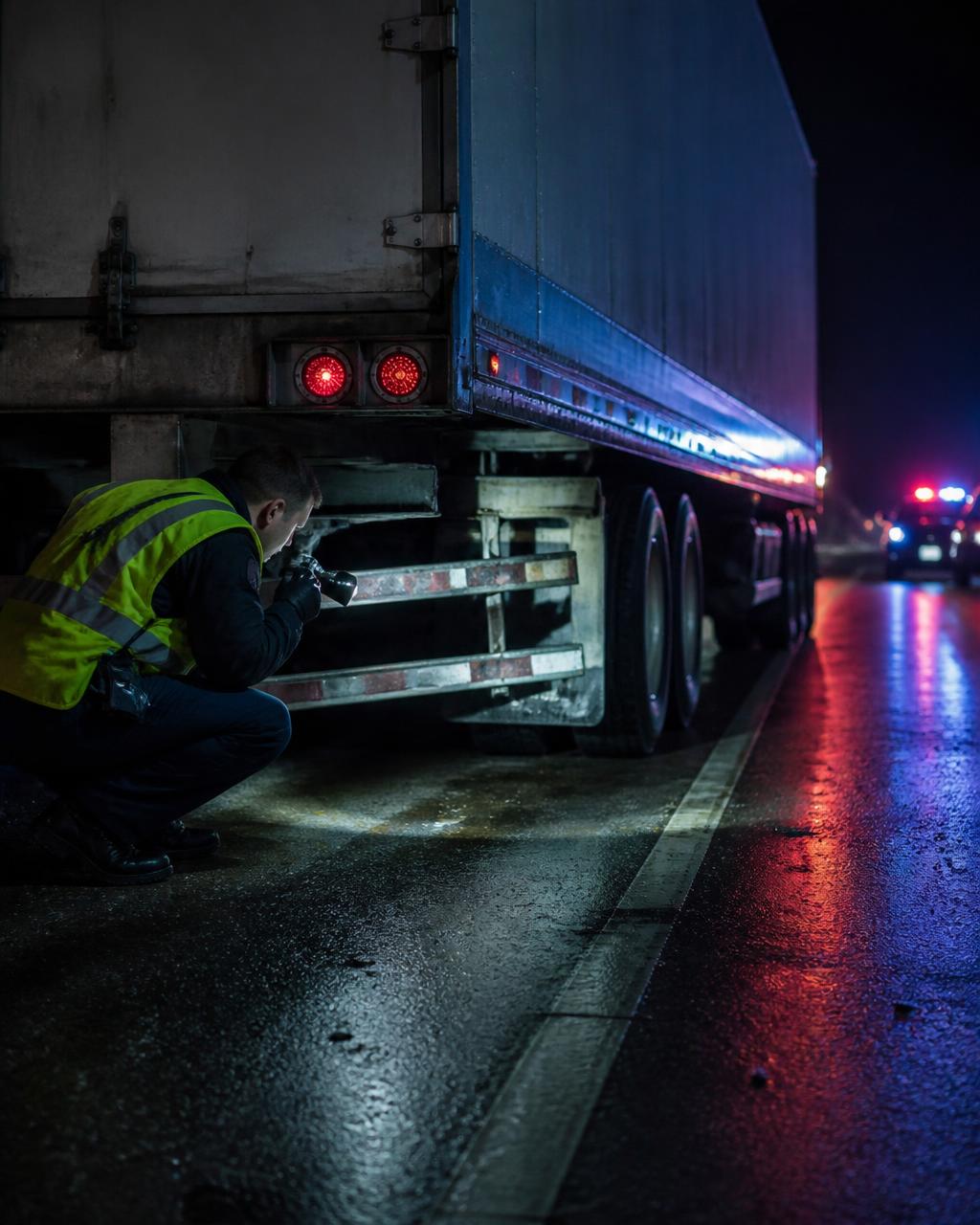
“Evidence in a truck case is on a retention schedule. The clock starts at impact, not when you feel well enough to call.”
The first month
A semi-truck case is built in the first weeks. This is the sequence we run while the carrier's own investigator is still on the scene.
Hours 0-24
A written demand to the carrier and its insurer to hold the ECM download, driver logs, dashcam footage and dispatch messaging before any retention cycle touches them.
Day 1-3
Photogrammetry of the scene, gouge marks and final rest positions, plus a hold on both vehicles so the tractor is not repaired, repainted or sold out from under the case.
Week 1
Driver qualification file, post-accident testing, maintenance and inspection history, bills of lading and weight tickets — the documents that decide fault before anyone is deposed.
Week 2-4
Data from the black box read against the physical evidence, then every party that touched the load — driver, motor carrier, broker, shipper, maintenance vendor — placed on the chart.
The record set
A serious case is won out of the defendant's own file. This is the list that goes into the preservation letter.

Free case review
Preservation notice is the difference between reconstructing the crash from data and arguing about it from memory.
No fee unless we win · Consultations are free and confidential
Straight answers
Federal safety rules generally attach to commercial motor vehicles with a gross vehicle weight rating of 10,001 pounds or more operating in interstate commerce, which sweeps in far more than classic tractor-trailers. Box trucks, dump trucks, tankers and many oilfield service vehicles carry the same FMCSA obligations for driver qualification, hours of service and maintenance.
The engine control module records data around a hard-braking or crash event: road speed, engine RPM, throttle position, brake application, and sometimes seatbelt and fault codes. Paired with the electronic logging device and GPS telematics, it can reconstruct the minutes before impact. It is also the first thing that disappears when a tractor is repaired or sold, which is why preservation notice matters immediately.
Rear underride guards are required on most trailers under 49 CFR § 393.86, with strength standards. Side underride guards are not federally required, despite long-standing safety recommendations. In practice we look hard at whether the rear guard met the standard, whether it was corroded or previously damaged, and whether the carrier inspected it.
No. A carrier that runs freight through Texas is subject to suit here, and interstate operation is precisely what triggers FMCSA jurisdiction. Out-of-state carriers are routine in Tyler cases, I-20 traffic is overwhelmingly through-traffic.